By 2035, artificial intelligence, automation, and demographic shifts will have fundamentally reshaped how, where, and why people work. This isn’t speculation: it’s already happening. Research shows that 39 percent of employees’ skill sets will transform by 2030, while 92 percent of companies plan to significantly increase their AI investments over the next three years. The COVID-19 pandemic from 2020–2022 accelerated remote work adoption by a decade, and the explosion of generative AI tools after 2022 has put the automation of knowledge work firmly on the table.
These changes aren’t just abstract trends for economists to debate. They’re reshaping the daily lives of workers, the strategies of business leaders, and the policy choices facing government at every level. This article will explore what technology will actually do to jobs, which skills will matter most, how society can share prosperity more broadly, and what practical steps workers, employers, and educators can take right now. The focus here is on helping you make concrete decisions about reskilling, automation, and job design: not just understanding what’s happening but figuring out what to do about it.
1. Technology and AI: what work will look like by 2030–2035
The most important thing to understand about AI and automation is that they’re changing tasks inside existing jobs rather than simply eliminating or creating entire roles. By 2030, most workers won’t be replaced by machines: they’ll be working alongside them, orchestrating and supervising intelligent systems while focusing on what humans do best.
Generative AI tools are already being embedded into everyday workflows across sectors. Customer service teams use AI assistants to draft responses that humans then review and personalize. Software developers work with coding copilots that suggest solutions while the human decides which approach fits the architecture. Medical professionals consult AI diagnostic assistants that flag patterns in imaging data, and researchers rely on automated, AI-assisted data labeling pipelines and high-quality labeled training data for modern AI systems to prepare large-scale datasets while incorporating human feedback in AI model development and why labeled data still powers the world's most advanced AI models, freeing doctors and data scientists to focus on patient relationships and complex judgment calls. These aren’t future possibilities: they’re happening now in hospitals using AI triage systems and factories deploying predictive maintenance.
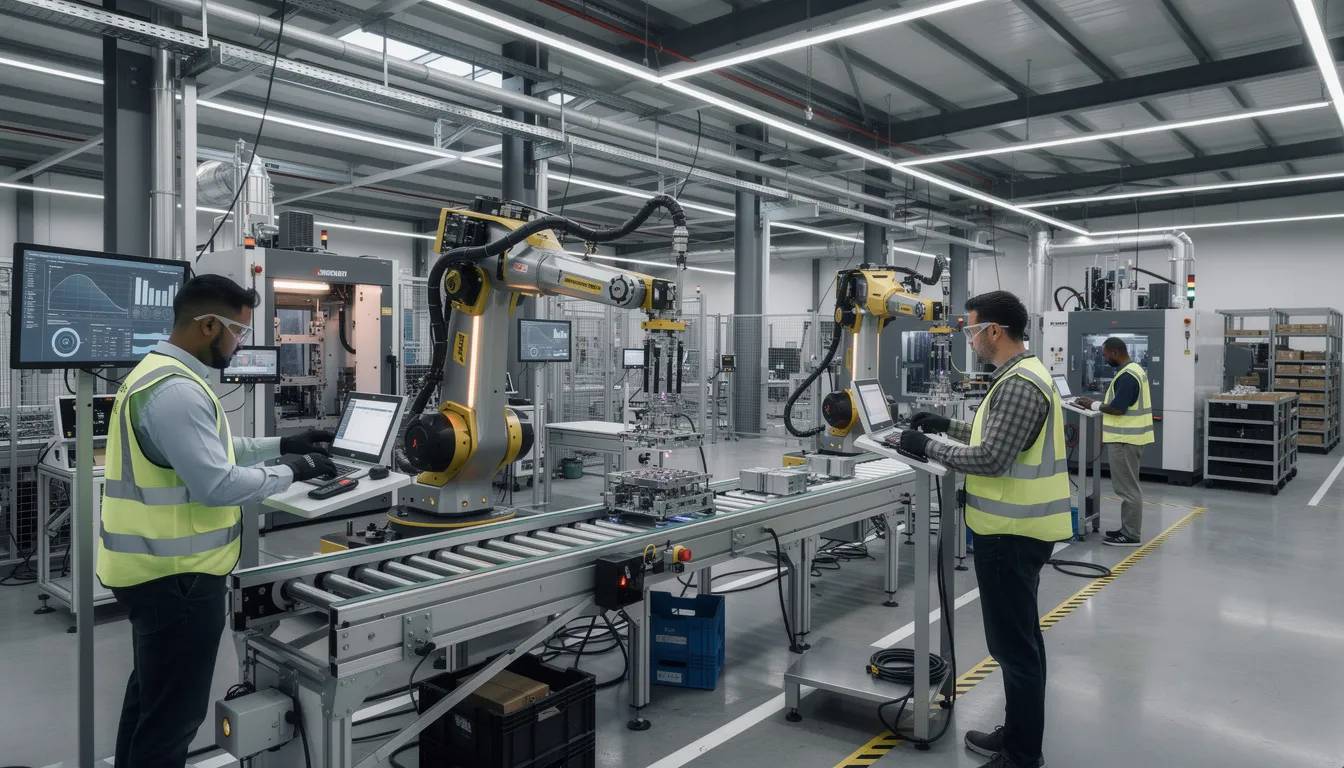
Several sectors face particularly high exposure to automation. Manufacturing continues its decades-long transformation with more sophisticated robotics and industry-specific AI applications across sectors like healthcare, finance, and automotive. Logistics is seeing warehouse automation and autonomous delivery pilots expand from 2025 onward. Routine clerical work: data entry, basic document processing, standard customer support: will shrink significantly as AI handles these tasks faster and at lower cost. White-collar roles like entry-level analysts and paralegals are also vulnerable, as recent layoff patterns suggest.
But the picture isn’t all job displacement. Growth areas include AI product management, data governance, cybersecurity, climate-tech roles, eldercare, and mental health services. The demand for expertise in managing human-AI collaboration will expand dramatically. By the early 2030s, the most common configuration won’t be “human versus machine” but “human with machine”: hybrid roles where workers bring creativity, judgment, and relationship skills while AI handles computation, pattern recognition, and routine execution.
2. New skills and lifelong learning in an AI-driven economy
Technical skills now have a shelf life of three to five years in many fields. The knowledge that got you hired five years ago may be obsolete by the time you’re up for promotion. This reality is forcing a fundamental shift in how we think about education, training, and career development.
By 2030, digital and AI-related skills will be baseline requirements across virtually every sector. Data literacy: the ability to interpret and work with data even without being a data scientist: will be as essential as reading and writing. Basic coding, prompt engineering for AI tools, cybersecurity hygiene, and fluency with automation platforms will be expected in roles from healthcare administration to marketing to public administration. Employers are already struggling to find talent with these capabilities: 74 percent report difficulty filling positions with appropriately skilled candidates.
Yet the skills that will matter most are distinctly human. Critical thinking, complex problem-solving, creativity, collaboration, negotiation, and cross-cultural communication become more valuable precisely because AI can’t replicate them. Learning budgets are shifting toward cognitive capabilities through problem-based learning with real-world scenarios, cross-functional challenges, and reflection exercises that build judgment rather than just knowledge.
Countries that recognize this are investing accordingly. Finland has long invested in adult education as a pillar of economic strategy. Singapore’s SkillsFuture program, expanded throughout the 2020s, provides citizens with learning credits and guidance for continuous upskilling. These national strategies treat lifelong learning not as a nice-to-have but as critical infrastructure for economic function.
The hiring world is also transforming. By the early 2030s, skills-based hiring will be standard practice for leading organizations. Employers are building internal talent marketplaces that match workers to projects based on capabilities rather than job titles. Portfolios, micro-credentials, and demonstrated competencies will stand alongside or replace, traditional degrees as proof of ability, especially as workers adopt AI research tools for data analysis and insights to showcase their capabilities. This shift opens access to opportunities for workers who may lack formal credentials but possess relevant skills.
3. The human edge: meaning, creativity, and agency in the future of work
Even as AI completes more tasks, uniquely human qualities: agency, narrative identity, moral judgment, and lived experience: remain central to valuable work. In fact, they become more important precisely because routine competence is increasingly automated.
Many workers today feel a loss of meaning and connection. Hyper-productivity metrics, algorithmic management, and fragmented work arrangements can make labor feel mechanical and disconnected from purpose. More than half of workers in some surveys report feeling disengaged from their work’s broader significance. This isn’t just an individual problem: it’s a society-wide challenge that affects productivity, innovation, and wellbeing.
By the 2030s, the most rewarding roles will be those built around creativity, relationship-building, trust, and stewardship. Therapists, coaches, designers, community organizers, and leaders of mission-driven teams will thrive because their value cannot be separated from who they are as people. The future belongs to what we might call “meaning economies”: where the creator’s story, taste, and trajectory are part of the product.
This shift has been building for years. The rise of creator economy platforms since 2015 and the explosion of independent knowledge workers post-2020 signal a broader cultural movement toward work that feels personally meaningful. Young people entering the labor force increasingly prioritize purpose alongside pay.
3.1 The evolution of meaning and work
Understanding where we’re headed requires understanding where we’ve been. Pre-industrial societies understood work primarily through religious and vocational frames: work as calling, as contribution to community, as moral discipline. The industrial era shifted focus to productivity and output. A worker’s value was measured in units produced, hours logged, money earned.
The knowledge economy of the late 20th century introduced another layer: work as self-realization. Career success became intertwined with personal identity and social status. The digital era has intensified both the opportunities and risks of this framing. Global creative reach and remote collaboration enable people to build audiences and businesses that were impossible a generation ago. But isolation, “bullshit jobs” that feel meaningless, and work detached from social impact have also proliferated.
Consider the trajectory: the post-World War II manufacturing boom created stable middle-class employment but often alienating assembly-line work. The rise of knowledge work in the 1980s–1990s promised more autonomy but brought its own pressures. Gig platforms after 2010 offered flexibility but often at the cost of security and belonging.
The future of work will likely reward roles that combine contribution, community, and personal growth rather than pure output volume. A software engineer who transitions into social entrepreneurship, or a nurse who integrates technology with compassionate care, exemplifies this evolution: finding meaning through the integration of technical skill with human connection.
3.2 The economic role of jobs in an automated age
Large-scale automation could, by the early 2030s, fundamentally challenge how society distributes income. If routine jobs disappear faster than new roles emerge: and early evidence suggests this is happening in white-collar sectors: wage-based income could stagnate or decline for significant portions of the labor force.
This isn’t just an economic matter; it’s a political one. When technological change concentrates gains among capital owners and highly skilled workers while displacing others, social stability comes under pressure. The promise of shared prosperity requires active intervention.
Several approaches are being debated and piloted. Universal basic income experiments in the late 2010s and 2020s tested direct cash transfers as a floor beneath which no one falls. Expanded negative income tax proposals would use the tax system to supplement low incomes. Employee ownership schemes, cooperatives, and shared data dividends could broaden access to capital ownership so that more people benefit from AI-driven productivity gains, particularly in sectors where human-centered AI research for market insights is reshaping how value is created.
Getting this wrong carries serious risks. If a small group captures most AI-driven gains while automation displaces workers without adequate support, inequality will deepen. Civil society, government, and business must collaborate on solutions that maintain work’s economic function while adapting to new realities.
4. The skill stack for the future: agency, taste, perspective, and persuasion
Think of human capabilities as a layered stack. At the base are technical skills: knowing how to use tools, including AI tools. Above that sit uniquely human capabilities that become more valuable as AI automates routine expertise: agency, taste, perspective, and persuasion.
By 2030, success will depend less on memorizing facts: AI can retrieve information instantly: and more on assembling unique combinations of these higher-order capabilities, including understanding what human feedback in AI is and how it shapes systems. What problems do you choose to work on? How do you frame them? How do you mobilize others to act? These questions matter more than ever as technology evolves.
Consider a product designer in the 2030s. Technical proficiency with design software and AI generative tools is table stakes. What distinguishes the exceptional designer is the ability to identify unmet needs (agency), select approaches that resonate (taste), understand context across disciplines and cultures (perspective), and communicate vision compellingly to stakeholders (persuasion). The same pattern applies to investigative journalists, startup founders, nonprofit leaders, and countless other roles.
4.1 Agency: owning work and navigating uncertainty
Agency is the capacity to initiate, choose, and sustain meaningful projects rather than simply reacting to assignments or algorithms. In a labor market characterized by frequent job transitions, portfolio careers, and project-based contracts, agency becomes critical for thriving.
Consider a factory worker in a region where manufacturing jobs are disappearing. Agency means recognizing the shift early, seeking information about growing sectors like renewable energy maintenance, pursuing relevant training, and taking the initiative to build connections in new industries. Between 2025 and 2035, this kind of self-directed transition will become increasingly common.
Building agency requires several supporting elements:
Self-directed learning habits: The ability to identify skill gaps and pursue knowledge without waiting for employer-provided training
Career experimentation: Willingness to try new roles, industries, or work arrangements
Personal safety nets: Financial reserves and social networks that enable bolder career moves
Comfort with uncertainty: Recognizing that linear career paths are artifacts of a different era
Agency doesn’t mean going it alone. It means taking ownership of your development while building relationships and systems that support adaptation.
4.2 Taste: curating value in an age of infinite content
Taste is the ability to discern what is meaningful, high-quality, and relevant amid overwhelming digital noise. By the late 2020s, AI will be capable of generating enormous volumes of text, images, code, and other outputs at minimal cost. Production becomes cheap; curation becomes valuable.
Editors who can shape AI drafts into distinctive voices will be more valuable than writers who simply produce volume. Marketers who select resonant narratives will outperform those who generate generic campaigns. Managers who prioritize truly impactful data signals will make better decisions than those drowning in dashboards.
Taste is developed through exposure, feedback, and deliberate practice: not innate talent. Someone who has read widely, received honest criticism, and refined their judgment through iteration develops taste. In research contexts, for example, teams can use AI-moderated qualitative interviews at scale to gather richer input that sharpens their sense of what truly resonates. It’s a trainable skill, but it requires time and intention.
The link between taste and trust is crucial. Audiences and employers will seek out people whose judgment consistently surfaces what matters. In a world where anyone can generate content, the person who can reliably identify what’s worth attention becomes indispensable.
4.3 Perspective and persuasion: making sense and moving people
Perspective is the ability to see patterns across disciplines, time horizons, and cultures, and to hold multiple viewpoints when solving complex problems. The most pressing challenges of the 2030s: climate adaptation, AI governance, demographic shifts, geopolitical tensions: cut across traditional silos. Leaders who can synthesize insights from technology, policy, culture, and history will navigate these challenges more effectively.
Persuasion is the capacity to communicate ideas clearly, build coalitions, and influence decisions. Technical analysis alone rarely drives action; the ability to translate insight into compelling narratives that move organizations and communities is essential.
Consider a manager advocating for responsible AI adoption in 2028. She must understand the technology, the regulatory landscape, the concerns of workers, and the competitive pressures facing the business, including how techniques like reinforcement learning from human feedback in AItraining affect system behavior. Then she must communicate a vision that addresses these different perspectives and builds support for action. Or consider a community leader organizing workers affected by automation: bringing together diverse stakeholders around shared interests requires both perspective and persuasion.
In the 2030s, the rarest and most rewarded workers will be those who can both understand complexity and move others to act on that understanding.
5. Public policy and institutional responses to the future of work
Individual adaptation matters, but it’s not sufficient. The scale of transformation underway requires coordinated responses from government, unions, educational institutions, and employers. The difference between technological change leading to shared prosperity versus deeper inequality depends substantially on policy choices made in the 2025–2035 period.
Since 2018, national and regional “future of work” offices and initiatives have proliferated. Colorado established an Office of the Future of Work in 2019. The European Union has developed Just Transition policies to support workers in carbon-intensive industries. The OECD convenes task forces examining labor market disruptions across member countries. These efforts represent a growing recognition that labor market transformation requires proactive governance.
Key policy levers include:
Investments in education and training systems are particularly critical. Early STEM exposure, robust vocational pathways, apprenticeships that connect learning to work, and publicly supported lifelong learning accounts can help the workforce adapt continuously rather than facing periodic crises. Potential policy interventions include modernizing labor laws for gig and platform workers to strengthen minimum standards, expanding portable benefits tied to individuals rather than employers, enhancing safety nets through stronger unemployment insurance and income support during transitions, and targeting support for underserved communities such as rural workers, older workers, and migrants. These measures collectively aim to prepare the labor force for ongoing technological change and demographic shifts, ensuring equitable access to opportunity and fostering a resilient economy.
5.1 National and regional “future of work” strategies
From 2018 onward, several governments have established dedicated offices or cross-ministerial working groups to anticipate labor disruptions. These bodies coordinate data collection, stakeholder engagement, and policy recommendations on automation, demographic shifts, and skill gaps.
A U.S. state office created in 2019, for example, convenes business, labor, and education leaders to identify emerging skill needs and design responsive training programs. A European country’s 2030 skills strategy sets targets for adult learning participation and digital literacy. A city program supports displaced workers from carbon-intensive industries with retraining subsidies and job placement assistance.
What makes these efforts effective is not just their existence but their processes:
Regular public reporting on labor market trends
Impact evaluation of interventions
Iterative policy updates as technologies and markets evolve
Genuine stakeholder engagement beyond token consultation
Leadership from both public and private sectors is essential. These aren’t problems government can solve alone, nor can business address them without policy support, especially as they confront emerging AI techniques such as RLHF, or reinforcement learning from human feedback that raise new governance questions.
5.2 Inclusive social contracts and worker protections
Traditional employment-based benefits, healthcare, pensions, unemployment insurance: were designed for an era of stable, full-time jobs with single employers. They struggle to cover freelancers, gig workers, and people holding multiple part-time positions.
Proposals for portable benefits address this gap. Instead of benefits being tied to a specific employer, workers would accumulate contributions from multiple platforms or clients throughout their careers. A rideshare driver, home care worker, or freelance designer would build protections across their various work arrangements.
Experiments are underway with stronger minimum standards for platform work, collective bargaining rights for nontraditional workers, and data transparency requirements for algorithmic management. These address concerns about surveillance and control in data-rich workflows without blocking innovation, and they intersect with debates over synthetic data vs human feedback for AI model training that influence how worker data is used.
By 2035, sustainable economies will likely have combined labor protections with room for entrepreneurship and flexible work arrangements. Getting the balance right requires ongoing negotiation among workers, employers, and policymakers: there’s no single formula that works for all contexts.
6. Practical roadmaps: how workers, leaders, and educators can act today
The future of work is not predetermined. Individual and institutional choices over the next decade will shape outcomes. Here’s how different actors can move from understanding to action.
For individual workers:
Build a learning habit: dedicate regular time to developing new skills, even if just an hour weekly, and experiment with AI research tools that streamline analysis, transcription, and data management
Experiment with AI tools at work; don’t wait for formal training to explore how they might augment your capabilities
Document your skills in a portfolio format that showcases what you can do, not just titles you’ve held
Cultivate networks across sectors and industries; diverse connections with top artificial intelligence experts in the United States and adjacent fields open unexpected opportunities
Take agency over your career development rather than waiting for employers to direct it
For employers and managers:
Design human-centered automation strategies that enhance rather than simply replace workers
Invest in upskilling as a first response to technological change rather than defaulting to layoffs
Involve employees in technology decisions; people support what they help create
Shift toward skills-based talent management that values capabilities over credentials
Create psychological safety for experimentation and learning from failure
For educators and training providers:
Align curricula with evolving industry needs through regular engagement with employers and experienced human capital consultants such as strategic HR leaders with workforce planning expertise
Integrate AI literacy and ethics across programs, not just in technical specialties
Partner with local employers for work-based learning that connects classroom knowledge to practical application
Build flexible credentialing systems that recognize competencies developed through multiple pathways
Support learners of all ages, recognizing that career-long education is the new norm
For cross-sector collaboration:
The most effective responses will come from partnerships across traditional boundaries. Governments, businesses, unions, nonprofits, and communities can collaborate on pilot projects testing new approaches, including how synthetic data generation can scaleAIdevelopment responsibly, regional skills alliances that coordinate training investments, and transparent data-sharing about labor market trends that helps everyone make better decisions.
The organizations that thrive will be those that treat workforce development as a strategic priority rather than an afterthought. The workers who succeed will be those who embrace continuous learning and maintain agency over their careers. The societies that flourish will be those that shape technological change to serve human flourishing rather than simply accepting whatever happens.
The future of work isn’t something that happens to you: it’s something you help create through daily choices about learning, adaptation, and collaboration. Whether you’re a policymaker designing support systems, a company investing in your team, or an individual charting your career path, the decisions you make now will determine whether the next decade brings shared prosperity or deepening division.
Start today. Experiment with one new tool. Have one conversation about skills development. Advocate for one policy that expands access to opportunity. The vision of work that combines productivity with meaning, innovation with security, and growth with fairness won’t build itself. But it can be built: and the building starts now.
Conclusion: shaping the future of work together
The future of work is unfolding rapidly, driven by advances in artificial intelligence, automation, and shifting societal needs. While these changes bring challenges such as job displacement and evolving skill demands, they also offer unprecedented opportunities for creativity, agency, and meaningful contribution. Success in this new landscape will depend on the ability of workers, employers, educators, and policymakers to collaborate and adapt proactively.
By embracing lifelong learning, fostering inclusive workplaces, and designing policies that support both innovation and equity, society can ensure that the future work not only sustains economic growth but also strengthens the social contract that gives work its purpose. The aim is clear: to create a world where technology evolves alongside human potential, enabling everyone to thrive in a dynamic, meaningful, and equitable labor force.
The point is not to fear automation or AI but to harness their power thoughtfully, ensuring that the economic function of work continues to provide dignity, opportunity, and shared prosperity. Together, we can shape a future of work that reflects our highest values and collective aspirations.






.png)